Beyond the Arc – Long Form Analysis
Last Updated – July 13th 2026
The Euro Step is an independent publication. All trademarks, logos and brand names are the property of their respective owners and are used for editorial, commentary and reporting purposes only. No affiliation or endorsement is implied.
Let’s face it, being an NBA fan in Europe can be difficult. Tip-offs arrive in the early hours of the morning. Podcasts are recorded while you’re asleep. Avoiding spoilers becomes a skill in itself if you want to watch the game later. At least the NBA App has improved.
For years, European fans have consumed the NBA from a distance. We have watched the best league in the world on American time, through American media, with American priorities. The appetite for basketball has never been the issue. Europe produces MVPs, fills arenas, and continues to send elite talent to the NBA.
Yet European basketball itself remains fragmented. Domestic leagues compete with continental competitions. Clubs answer to multiple governing bodies. Schedules clash. Revenues vary widely.
The talent is here. The fans are here. The infrastructure already exists. What has been missing is a unified commercial vision. That is the opportunity the NBA believes it can exploit.
Enter NBA Europe.
Still in development, the proposed league is a joint project between the NBA and FIBA that aims to reshape professional basketball across Europe. It has the potential to transform the sport’s financial landscape, attract new investment, create new rivalries and change the relationship between European clubs and the NBA forever.
So, what exactly is NBA Europe, and why is everyone suddenly talking about it?
What is NBA Europe?
The vision appears to be clear: in simple terms, the NBA wants a premium basketball league in Europe featuring the continent’s strongest markets, biggest clubs and most valuable commercial opportunities.
“Basketball’s probably the fastest-growing sport in the world right now, and it’s a huge No. 2 sport in Europe behind soccer, so I think there’s a real opportunity,” NBA Commissioner Adam Silver said.
The reported structure is a 16-team competition featuring 12 permanent franchises alongside four qualification places. Those permanent franchises would be centred around some of Europe’s biggest cities and commercial markets, with valuations reportedly ranging between $500 million and $1 billion.
Many of the finer details remain unknown. How qualification would work, how domestic leagues would fit around the calendar and exactly how franchises would be selected are all questions still waiting to be answered. What appears far less uncertain is the NBA’s desire to move quickly.
“I don’t think I’d want to go much longer than ’28,” Silver said. “The opportunity is now to do something like this.”
A launch as early as October 2027 has been discussed. With the end-of-June deadline for franchise bids now passed—and reports of significant interest—the project has continued to move beyond discussion and into execution. If it isn’t already obvious, this is as much a business project as it is a basketball one.
Leah MacNab, the NBA’s Senior Vice President and Head of International Strategy & Operations, explained the thinking to Boardroom: “We have been talking about this for decades at the NBA. We think that the current structure really doesn’t take advantage of the commercial opportunities. So, we wanted to put our hats in the ring, and we’re really excited to take this to the next step.”
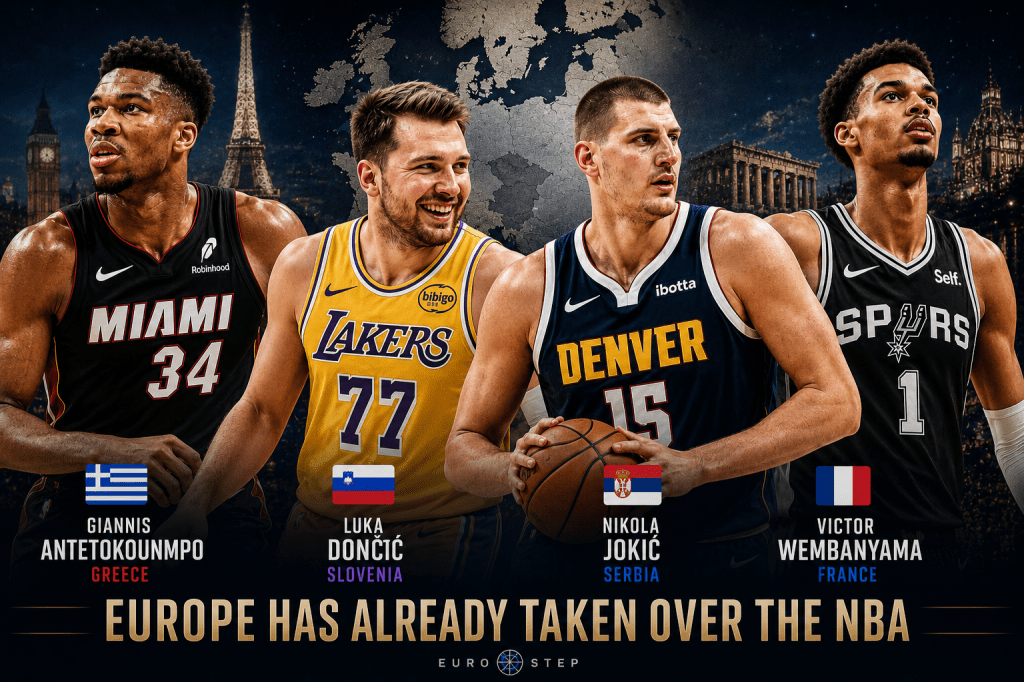
The timing is no coincidence. Around 15 per cent of NBA players now come from Europe, and they are no longer simply filling roster spots. Many of the defining stars of the modern era developed in European basketball systems before becoming some of the most influential players in the league.
From three-time MVP Nikola Jokić to the Greek Freak, Giannis Antetokounmpo. From Luka Dončić, now expected to lead the Lakers into their next era, to Victor Wembanyama, the player many believe will become the NBA’s next global superstar. These players have become more than elite basketball players; they are global icons, inspiring the next generation of talent across Europe.
That success creates a cycle. Young fans see European stars dominating the NBA and want to follow in their footsteps. Federations invest more heavily in coaching and development. Clubs produce more elite talent. Meanwhile, streaming services such as League Pass make it easier than ever for European audiences to follow the league. The access is there. The timings are not.
From the NBA’s perspective, Europe already possesses almost everything required to support a world-class league. The cities are global destinations. The arenas are already full. The transport links, media networks and commercial partners are firmly established. Unlike launching in an emerging market, the NBA would be entering an ecosystem that already understands and embraces basketball.
Its recent activity reflects that thinking. After returning to London for the first time in seven years, the league has also targeted Paris, Berlin and Manchester for future regular-season games. None of that appears accidental. The NBA is testing markets, building relationships and measuring demand.
The choice of cities is revealing. They are not simply basketball locations; they are major commercial hubs with international reach. The NBA already knows basketball works in Europe. The question now is whether a permanent European league can become one of the most valuable sports businesses on the continent.
And perhaps the NBA’s biggest opportunity isn’t basketball at all. It’s branding.
The Branding
NBA team brands are true commercial crossover elites. Take the Bulls, Lakers and Knicks. No matter how well they are performing on the hardwood, they remain global businesses with enormous audiences, merchandising power and cultural relevance that stretches far beyond basketball.
The NBA appears to be searching for the European equivalent.
Basketball teams already exist under some of Europe’s biggest sporting brands, including Real Madrid, Bayern Munich and Paris Saint-Germain. Imagine those names competing within a premium NBA-backed competition. Suddenly, the league isn’t simply selling basketball. It’s selling some of the world’s most recognisable sporting identities.
This is where the foundations of NBA Europe begin to make sense. Anyone familiar with football’s proposed European Super League will immediately recognise the blueprint: the biggest clubs, the biggest markets and the strongest commercial opportunities brought together under one competition.
The crucial difference is that basketball may be far better suited to the concept than football ever was.
Football’s backlash came from the belief that the Super League threatened the foundations of the sport. Basketball, by contrast, has spent decades embracing franchise systems, permanent memberships and commercially driven competitions.
European basketball already operates far closer to the American model than European football ever has. EuroLeague itself is built around long-term licences, permanent clubs and commercial partnerships.
What the NBA appears to have recognised is that many of the structural and commercial foundations are already in place. Its confidence lies in the belief that it can package, market and monetise European basketball more successfully than Europe has managed itself.
Viewed through that lens, NBA Europe feels less like a revolution and more like the natural next step in the sport’s commercial evolution.
Who’s Involved?
The NBA are clearly serious about the project and have been working closely with JP Morgan Chase and The Raine Group, two organisations with extensive experience in sports finance, investment and strategic advisory work.
Reporting from The Athletic has provided perhaps the clearest indication yet of the scale of those discussions. Meetings in London and Berlin reportedly brought together representatives from some of Europe’s biggest basketball clubs, including Real Madrid, Barcelona, Panathinaikos and Fenerbahçe, alongside organisations better known for football, such as Bayern Munich, Manchester City and AC Milan. ASVEL owner Tony Parker also provides another influential basketball voice, giving Lyon a seat at the table.
Once organisations of this size enter the conversation, the project stops looking like a basketball initiative and starts looking like a major European business venture. This is no longer simply a discussion about a new sports league. It is a discussion involving some of Europe’s biggest sporting brands, major media markets and significant commercial opportunities. That is why private equity and sovereign wealth have also been linked to the project. Saudi Arabia’s Public Investment Fund, Qatar Sports Investments, Blackstone and Arctos have all reportedly been involved in discussions around NBA Europe.
Perhaps the clearest example of how influential figures are already positioning themselves comes from current Lakers superstar Luka Dončić and former Dallas Mavericks executive Donnie Nelson.
The pair first worked together when Nelson helped bring Dončić to Dallas in 2018. They have since led the purchase of Italian club Vanoli Cremona, with plans to relocate the team to Rome ahead of the 2026-27 season. Joining them in the ownership group are former Italian league player Rimantas Kaukėnas and veteran coach Valerio Bianchini.
Rome has long been viewed as one of Europe’s most attractive untapped basketball markets and has repeatedly been linked to NBA Europe. If the league is ultimately built around major cities, global brands and major commercial opportunities, Rome fits the profile almost perfectly. That makes Dončić’s investment difficult to dismiss as coincidence.
“I have dreamed about owning a team in Europe for a long time, to finally have this happen is amazing,” Dončić said.
“Vanoli has a great history, and we are ready to take it to the next level in Rome.”
Timing matters. An active NBA superstar and a longtime NBA executive have not simply invested in European basketball. They have invested in Rome. Just as in the NBA, the city comes first. The franchise fits around it.
It is also no surprise that NBA superstars have been investing in football clubs and sports franchises for years. The crossover between sport and business is becoming increasingly difficult to separate.
LeBron James owns a stake in Liverpool FC. James Harden, Kevin Durant and Magic Johnson have all invested in football clubs or sports franchises. For modern athletes, ownership is increasingly viewed as the next stage of their careers rather than the final reward.
Perhaps LeBron summed it up best when he told The Wall Street Journal in 2011:
“The first time I stepped on an NBA court I became a businessman.”
Viewed in that context, Dončić’s move into ownership feels far less surprising.
The more interesting question isn’t why an NBA superstar bought a European basketball club.
It’s why he chose Rome.
And why he chose now.
Just as importantly, the NBA also appears to be placing experienced basketball people in key positions. George Aivazoglou has been tasked with leading NBA Europe, while the recent appointment of former Chicago Bulls executive Artūras Karnišovas as a consultant and liaison further strengthens the project’s leadership. Alongside them, Pau Gasol has increasingly emerged as a respected figure capable of bridging the NBA, FIBA and European basketball.
Every successful team needs a point guard. While investors may provide the resources and clubs the competition, it is often the people connecting different organisations and basketball cultures who determine whether a project truly succeeds. As NBA Europe continues to take shape, the league appears determined to put the right playmakers in a position to make the right plays, way before the opening tip.
The Fight
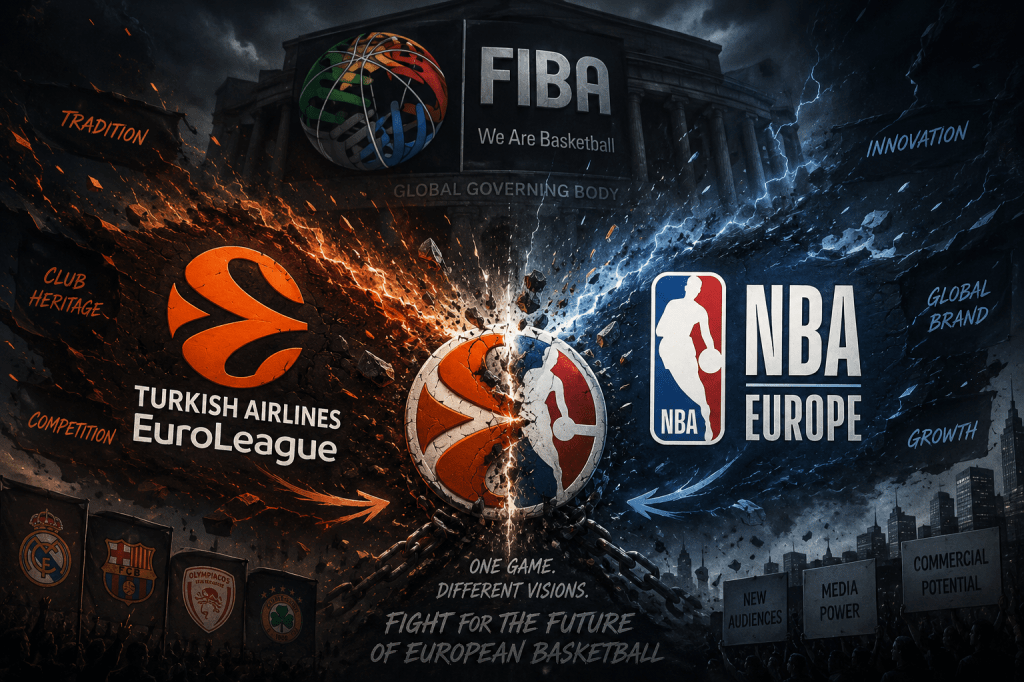
No project of this scale arrives without opposition. For NBA Europe, that opposition is EuroLeague.
FIBA, basketball’s global governing body, first introduced Europe’s premier club competition in 1958. Over the last 25 years, however, it has gradually lost control. Following a split in 2000 with the Union of European Leagues of Basketball (ULEB), many of the continent’s leading clubs backed the new structure, with ULEB ultimately emerging in control of what became the modern EuroLeague.
Today, EuroLeague is a privately run competition controlled by EuroLeague Commercial Assets. It has spent more than two decades establishing itself as Europe’s premier club competition and is unlikely to surrender that position without a fight.
Reports suggested EuroLeague had sent a legal letter to the NBA warning against discussions with clubs already tied to EuroLeague agreements. Silver’s response was characteristically brief.
“I send the legal letters to my lawyers, so I’ll let them handle that.”
It may not be quite that simple. EuroLeague shareholders such as Barcelona are reportedly protected by exit clauses worth around €10 million. In a project where franchise valuations are being discussed in the hundreds of millions, however, that figure may prove less significant than it first appears.
“I don’t think by any means it’s inevitable that there is a clash,” Silver said when asked about EuroLeague. Yet his most revealing comment may have been what followed. “If I thought that the ceiling was the existing EuroLeague and their fan interest, we wouldn’t be spending the kind of time and attention we are on this project.”
MacNab has made a similar argument, suggesting that NBA Europe and EuroLeague could ultimately coexist. The NBA, and importantly FIBA alongside it, has reportedly approached EuroLeague on several occasions but has yet to find a partnership structure that satisfies both sides.
EuroLeague appears less convinced.
“The NBA has been announcing and announcing things for a year, but still it’s nothing that you can grasp on,” EuroLeague CEO Paulius Motiejūnas told the Associated Press. “We’ve only heard the plan or the fireworks of how amazing it will be, how much potential there is. The ’27 start is already around the corner.”
Taken at face value, these comments do not sound like two organisations moving towards partnership. They sound like two organisations preparing for a contest over the future of European basketball.
The NBA insists coexistence is possible. EuroLeague remains sceptical. FIBA’s position makes the situation even more intriguing.
FIBA stood alongside the NBA when NBA Europe was announced and appears far more aligned with Silver’s vision than with the competition it originally helped create. The NBA seems determined to keep that relationship close, strengthening its position should it ultimately decide to move directly into EuroLeague’s space.
The public statements from both organisations tell their own story. “The European basketball community is proud of its seven-decade history of international club competitions and the elite talent it develops,” said FIBA Secretary General Andreas Zagklis.
“Yet given the sport’s popularity and the success of national team competitions, there is untapped potential in European club basketball. A new league in Europe would combine the NBA’s business acumen with the international expertise of FIBA to attract new basketball fans and investors alike, maximise club benefits and establish synergies for the benefit of all stakeholders.”
Silver struck a similar tone. “The NBA and FIBA are uniquely positioned to build on the rich tradition of European basketball,” he said. “We look forward to collaborating with FIBA to explore the creation of a new league for fans across the continent.”
What that ultimately means for EuroLeague remains one of the biggest unanswered questions surrounding the project.
There may also be another reason for the NBA’s confidence.
Part of its belief stems from the view that the current European basketball model is financially flawed.
Analysis commissioned by The Raine Group identified one of the sport’s biggest structural challenges. Collectively, EuroLeague clubs lose around €200 million every year in pursuit of on-court success. For many owners, competing at the highest level of European basketball has become a prestige exercise rather than a sustainable business.
It was a state of affairs that concerned Alba Berlin owner Axel Schweitzer enough to withdraw his club from the competition.
“Imagine running a business that loses over €200m a year continuously?” Schweitzer wrote on LinkedIn last May. “This isn’t meant to criticise. It’s just an observation. One that makes me reflect on how we can do things differently.”
For the NBA, this is not simply a weakness in the current system.
It is the opportunity.
The Buzzer Beater
If NBA Europe secures the brands it is targeting, while attracting the people, attention and investment already circling the project, then the scale could be enormous.
Basketball fans around the world would stand to benefit. Europe could finally have a genuine elite competition featuring many of the continent’s biggest clubs, strongest markets and best players. Increased revenues would likely flow throughout the game, benefiting clubs, arenas, broadcasters, sponsors and players alike.
Looking beyond the obvious battle between the NBA and EuroLeague, however, there are still several challenges that could prove more difficult than attracting investment or convincing clubs to join.
The NBA may believe European basketball is under-commercialised, but European sport has a long history of resisting solutions that appear logical on paper. Football’s failed European Super League remains the obvious warning. If supporters rejected a closed competition involving clubs they had followed for generations, how would they react to a competition built around newly created franchises or ownership groups backed by sovereign wealth and private equity?
The challenge is not whether Europe has the infrastructure. It clearly does. The challenge is who controls it.
Many of Europe’s leading basketball clubs already have long-established relationships with arenas, municipalities and local partners. The NBA is not entering an empty market waiting to be developed. It is entering an existing sporting ecosystem where many of the key assets are already tied to organisations with their own interests and ambitions. Building a league is one thing. Successfully integrating it into an already established basketball landscape is another.
The proposed qualification places raise another interesting question. One of the biggest attractions of a franchise model is certainty. Investors paying hundreds of millions of dollars for a place in the competition generally expect scarcity and protection. Qualification introduces uncertainty. It makes sporting sense within the European model and helps satisfy FIBA’s desire to preserve a pathway into the competition, but it sits awkwardly alongside the franchise valuations reportedly being discussed.
There is also a broader question about whether the NBA is identifying a problem or simply inheriting one.
EuroLeague clubs reportedly lose around €200 million collectively every year, a figure frequently cited by supporters of NBA Europe. Yet EuroLeague is hardly unaware of those financial challenges. The competition has spent years refining its commercial model, improving media rights and searching for ways to grow revenues across the continent.
Interestingly, the NBA is not pretending the road will be profitable from day one either. Reports suggest the league has offered assurances that it would cover early financial losses until the competition becomes self-sustaining. That represents a significant financial commitment and underlines just how confident the NBA is in the project’s long-term commercial potential.
The NBA’s argument is that European basketball can be packaged more effectively, distributed more widely and monetised more successfully. It may be right. The question is whether the issue has really been poor execution, or whether European basketball has structural limitations that no league, NBA-backed or otherwise, can fully overcome.
That may ultimately become the defining question of the entire project.
If Adam Silver and the NBA remain on course for a 2027 launch, then many of the pieces already appear to be in place.
The investors are there. The cities are there. The clubs are talking. Players are buying teams. FIBA is on board. Even EuroLeague’s resistance serves as evidence that this is no longer a theoretical exercise.
That does not mean NBA Europe is inevitable. European sport has a habit of frustrating even the most carefully constructed business plans. Questions around culture, governance, qualification and existing competitions remain unresolved.
But one thing no longer seems open to debate. Europe loves basketball.
It produces MVPs. It fills arenas. It develops some of the best players in the world. It watches the NBA in huge numbers.
The NBA believes Europe has the foundations to support something even bigger.
If Adam Silver’s timeline holds, basketball could look very different by October 2027. Between now and then, investors will make decisions. Clubs will choose sides. Partnerships may form, while others could collapse. Every announcement will reveal another piece of the puzzle. The countdown has already begun.
Join the Newsletter
Beyond The Arc long reads and Lay Up quick hits straight to your inbox.
If you made it this far, you’re serious about the game.
Join the newsletter for every long read and quick hit.
 The Euro Step
Leave a comment