The Battle for European Basketball
Just weeks after NBA Europe finalised its reported franchise bidding process, EuroLeague launched an investment drive of its own.
Coincidence? Perhaps. But the timing is difficult to dismiss. The NBA is building a new league, appointing executives, attracting investors and targeting some of Europe’s biggest cities. EuroLeague, meanwhile, is securing clubs, raising capital and reinforcing the competition it has spent decades building.
What makes this contest so unusual is that neither organisation appears to be preparing for the other’s success.
The NBA is acting as though NBA Europe is inevitable. EuroLeague is acting as though it can remain the continent’s leading competition. Both are investing. Both are expanding. Both are making long-term decisions based on the assumption that they will occupy the same space at the top of European basketball.
That is what makes this more than an expansion story. It is a strategic contest between two competing visions for the future of the game. One believes European basketball can become a global commercial platform built around internationally recognised brands. The other believes its future should remain with the clubs, rivalries, supporters and culture that have defined the sport across the continent for decades.
The battle for European basketball is no longer being fought through rumours and speculation. It is being fought through investment, appointments, partnerships and competing plans for the future. Before a single NBA Europe game has been played, both organisations have already begun positioning themselves to win.
The NBA — Outside the Perimeter
The NBA is not arguing that European basketball itself is broken. It is arguing that the business surrounding it has never realised its full potential.
Leah MacNab, the NBA’s Senior Vice President and Head of International Strategy and Operations, explained that thinking to Boardroom: “We have been talking about this for decades at the NBA. We think that the current structure really doesn’t take advantage of the commercial opportunities. So, we wanted to put our hats in the ring, and we’re really excited to take this to the next step.”
Rather than relying solely on existing basketball institutions, the NBA appears to be targeting major sporting brands, international investors and globally recognised cities capable of supporting a premium competition, even where those brands sit outside basketball itself.
Franchise bids were submitted at the end of June, while the football World Cup provided a convenient backdrop for discussions over long-term agreements with prospective ownership groups. With October 2027 being considered as an ambitious launch date, the NBA is moving quickly.
Then came EuroLeague’s response. Only weeks later, it was inviting expansion investment of its own. The timing is difficult to dismiss. Arriving so soon after the NBA’s franchise process, it looks less like the execution of a long-prepared strategy and more like a reaction to a competitor that has suddenly changed the market.
EuroLeague’s response is not necessarily misguided. Its existing clubs, history and infrastructure may yet offer investors a more attractive long-term proposition than the NBA expects. Whether by design or necessity, however, it is responding to a market the NBA has already begun to reshape.
EuroLeague now appears to be changing its rotations, adding financial depth and strengthening its perimeter defence before the NBA can apply further pressure. Reports have placed the potential value of investment into EuroLeague at as much as €1.2 billion across the competition, while proposed NBA Europe franchises have individually been discussed at valuations approaching $1 billion.
Those figures are not directly comparable, and both remain dependent on the eventual structure of each competition. Even so, they indicate the imbalance shaping the contest. The largest pools of capital appear to be gathering around the NBA, and where the biggest money goes, the biggest brands are likely to follow.
The NBA may have spent much of its early campaign shooting from the outside, but its greatest advantage could lie inside the European game itself.
The NBA’s Inside Game

The NBA is not arriving in Europe as a stranger. It has spent decades building influence across the continent, with European players becoming central to the modern NBA. Many of the league’s greatest current stars were developed in Europe before becoming global names under the NBA banner, while coaches, executives and former players have moved between the two basketball worlds and retained relationships on both sides of the Atlantic.
That gives the NBA something more valuable than simple name recognition: trusted messengers who already understand European basketball, its institutions and its culture.
The NBA has also developed a close working relationship with FIBA, the governing body with which EuroLeague has repeatedly clashed. That relationship offers institutional access, sporting legitimacy and potential routes into national federations, qualification systems and domestic basketball structures. EuroLeague may control the continent’s leading club competition, but the NBA has aligned itself with the organisation responsible for the wider international game.
Then there is Victor Wembanyama. Paris could become one of the most important markets in the entire contest, and France’s most recognisable basketball player is already an NBA star. Wembanyama belongs to France, but his global platform belongs to the NBA. Every appearance, commercial campaign and international moment strengthens the connection between the future of French basketball and the league that employs him.
His influence is already measurable. During the 2026 NBA Finals, French viewership across the five-game championship series increased by 265% compared with 2025, making the Knicks–Spurs Finals the most-watched NBA Finals on record in France. Wembanyama has become the clearest example of how the NBA can deepen its relationship with an entire national market.
The same pattern exists elsewhere. Nikola Jokić, Giannis Antetokounmpo, Luka Dončić and generations of European players stretching back to the 1980s have helped the NBA establish credibility across the continent without operating a European league of its own.
Those relationships can also be seen in the people already embedded across European basketball. Tony Parker owns ASVEL in Lyon, where Nicolas Batum is also involved. Artūras Karnišovas has been appointed as a consultant and liaison for NBA Europe, Pau Gasol has spoken about exploring opportunities involving Barcelona, and former Dallas Mavericks executive Donnie Nelson and Luka Dončić have acquired Vanoli Cremona with plans to relocate the club to Rome.
Taken together, those names provide the NBA with a network of players, executives and owners who understand both basketball cultures. Its greatest advantage may not simply be that it is the largest basketball brand in the world, but that after decades of relationships it is already embedded within the ecosystem it now wants to reshape.
Both the NBA and EuroLeague believe European basketball is entering a significant period of commercial growth. The question is no longer whether the sport can become more valuable. The question is who will win possession of that value.
The Battlegrounds
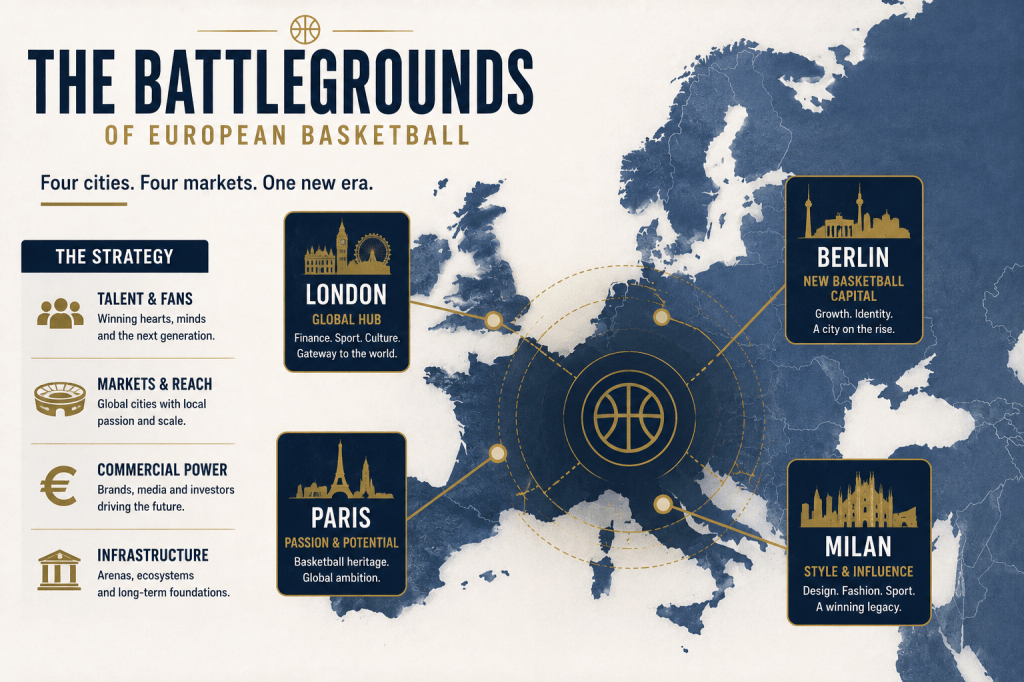
Sometimes the most important games are decided by individual matchups. Across Europe, several major cities now reveal the competing strategies of the NBA and EuroLeague most clearly.
Milan: The Proof of Concept
Milan perfectly illustrates the NBA’s strategy. EuroLeague already possesses one of Europe’s historic basketball institutions in Olimpia Milano, yet the NBA has been linked with AC Milan and its ownership group.
That distinction is revealing. EuroLeague naturally sees a major basketball club with history, supporters and an established position in the competition. The NBA appears to see the wider city, the global visibility of AC Milan and the opportunity to attach basketball to one of the most recognisable sporting brands in the world.
Milan therefore represents more than a potential franchise location. It may be the clearest early proof of concept for the NBA’s approach: not simply selecting basketball clubs, but selecting global sporting ecosystems.
London: The Unsecured Market
London presents a different challenge. Anyone looking at the continent’s leading basketball competition could reasonably ask why one of Europe’s largest cities and most important financial markets does not have a permanent EuroLeague team.
That absence has created an opening. The NBA has repeatedly identified London as a priority market, while EuroLeague had explored pathways for the London Lions to join the competition from the 2026–27 season, without success. The urgency surrounding London appears to have increased as the NBA’s intentions have become clearer.
London is therefore not merely a possible expansion city. It is evidence of EuroLeague being forced to defend territory it never fully secured, and a test of whether either competition can truly claim Europe’s largest untapped basketball market.
Berlin: The Test of the Model
Berlin may be the strongest example of the opportunity the NBA believes it can exploit. ALBA Berlin left EuroLeague after raising concerns about the financial model and the difficulty of building a sustainable business within the competition. The departure removed one of the league’s most important clubs from one of Europe’s largest and most strategically valuable cities.
The NBA is entering Europe with a different promise. It believes the commercial potential exists and has indicated that its model could absorb early losses while the competition develops. For a club that has already experienced the financial limitations of EuroLeague, that proposition may be difficult to ignore.
EuroLeague, however, is keen not to abandon Berlin. Its latest expansion and investment discussions include a desire to restore a team in the German capital. Whether that means repairing its relationship with ALBA or building around a different organisation remains unclear. What is clear is that Berlin now matters in a different way: the NBA wants to prove that a major European basketball city can become profitable, while EuroLeague needs to prove that its own model can retain or rebuild a presence there.
Berlin is therefore not only a battle for a city. It is a test of which competition can build a sustainable future around an established basketball market. If Milan is a test of the NBA’s commercial vision, Berlin is a test of EuroLeague’s existing business model.
What EuroLeague Still Holds
EuroLeague is clearly not defenceless. It still owns home-court advantage: the clubs, supporters, rivalries, coaches, executives and basketball knowledge required to operate at the highest level. It understands the cultural differences between Athens, Istanbul, Madrid and Paris because it has spent decades competing within them. That infrastructure cannot simply be recreated by attaching famous brands to major cities.
It can also make a powerful sporting argument. Its basketball is more tactical, more intense and more closely connected to local identity than anything NBA Europe is likely to produce initially. Its clubs carry histories that cannot be manufactured through franchise fees, investment rounds or marketing campaigns.
The question is not whether EuroLeague can offer elite basketball. It unquestionably can. The question is whether it can build a commercial platform and global brand powerful enough to compete with the NBA.
EuroLeague is not backing down. It has continued to secure clubs through longer-term agreements, most established teams remain committed and no major club has publicly abandoned the competition in favour of NBA Europe. Those are important signs of stability, although the real test will come once NBA Europe begins announcing ownership groups, cities and formal offers.
That remains EuroLeague’s greatest advantage. It already has a functioning competition, an established calendar, recognised teams and deeply committed supporters. The NBA must still turn meetings, bids and reported interest into a league by establishing franchises, securing arenas, recruiting players, coaches and executives, negotiating media agreements and building infrastructure across multiple countries. EuroLeague is defending an existing competition; the NBA is still attempting to create one.
The contest will not be decided by the quality of the basketball alone. It will also be shaped by investment, visibility, commercial partnerships, global recognition and the ability to convince Europe’s most powerful sporting institutions that one competition represents the future.
EuroLeague may possess the stronger existing basketball ecosystem. The NBA has the larger name, deeper global influence and, seemingly, heavier financial backing. One side is attempting to preserve and strengthen what already exists; the other is attempting to redefine what European basketball could become.
Before a single NBA Europe game has been played, EuroLeague already finds itself defending the floor. Its greatest test may still lie ahead. EuroLeague has retained its biggest clubs, but what happens if one decides the future lies elsewhere? If a club such as Real Madrid were ever to leave for NBA Europe, the contest would immediately shift from a battle for expansion to a battle for legitimacy.
Who Decides the Winner?
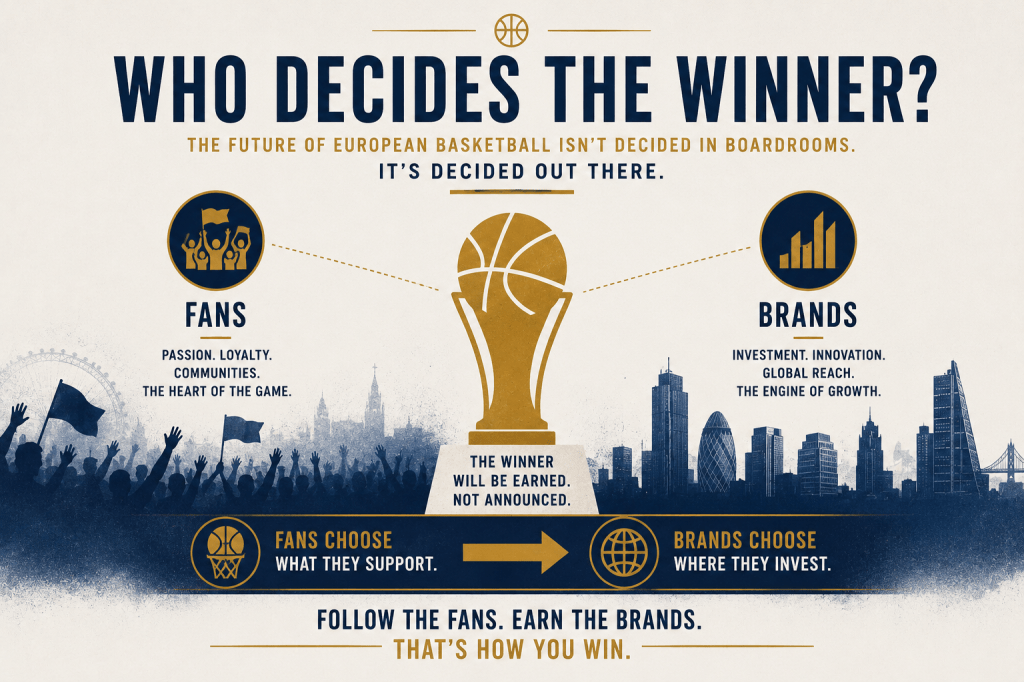
Can two elite continental competitions survive in the same market? It is difficult to imagine both reaching their full commercial ambitions without competing for many of the same cities, investors, broadcasters, clubs and supporters.
There are also major questions surrounding the NBA’s project. Can NBA Europe get off the ground? Will it announce its first franchises? Will it ever reach opening night? Interest, investment and influential relationships can create momentum, but they do not guarantee a functioning competition.
The reaction of supporters may prove decisive. European football fans helped destroy the proposed Super League almost immediately after it was announced, and some of the same football institutions and executives associated with that failed project have since been identified with the NBA’s European ambitions. That history cannot be ignored.
If supporters embrace NBA Europe, clubs may reconsider their positions, major brands may align and merchandise, media rights and ticket sales could follow. If they instead decide they prefer European basketball as it already exists—historic clubs, EuroLeague traditions, sporting identity and an improved version of the current competition—the NBA may struggle to gain traction.
The NBA can bring money, brands and the most recognisable name in basketball. What it cannot do is manufacture acceptance. However powerful its commercial proposition may be, it must persuade European basketball supporters that it is building something for them rather than simply extracting value from their market.
Who will win the Battle?
The NBA is not coming to Europe because European basketball has failed. It is coming because European basketball has already proved its value, surpassing what many believed the sport could become on the continent, without converting that success into the scale, profitability and global reach the NBA believes is possible.
EuroLeague owns much of the culture, history and existing basketball infrastructure. The NBA believes it can build the larger commercial platform. Some will argue that the eventual solution is a merger, but the evidence today suggests otherwise. Both competitions are behaving as though they expect to compete, not collaborate.
If this contest eventually produces a winner, it is unlikely to be decided by who plays the better basketball. It will be decided by which organisation convinces Europe that it represents the future of the game.
That may ultimately require the NBA’s commercial power, EuroLeague’s basketball heritage, or perhaps some combination of both. Today, however, the evidence points in a different direction. Both competitions are behaving as though they expect to win. Neither so far is preparing to lose.
@
 The Euro Step
Leave a comment