London’s absence from Europe’s basketball elite has long felt like an anomaly. Despite being home to the London Lions—Britain’s leading professional basketball club—the capital does not currently have a representative in the EuroLeague, widely regarded as the pinnacle of European club basketball. For a city of London’s size, influence and global sporting profile, that disconnect has become increasingly difficult to ignore.
Now, with six reported investment groups competing for a future NBA Europe franchise, the battle is revealing something far bigger than where a team might play. It is revealing why London has become one of the most valuable strategic prizes in European basketball.
For decades, Europe’s elite clubs have been concentrated elsewhere. Madrid, Barcelona, Athens and Istanbul have become synonymous with the sport, while Paris has rapidly emerged as a modern success story. London, despite being one of the world’s most influential cities, has remained on the outside looking in when it comes to the EuroLeague. That reality may finally be about to change.
Anyone discovering European basketball for the first time would reasonably expect London to be home to one of its flagship organisations. Instead, Britain’s capital has watched from afar while other cities established themselves as the sport’s traditional powerhouses. Unlike many of the markets linked with NBA Europe, however, London’s case is not built around a single historic basketball institution, an iconic coach or a dominant European club. It is built around something arguably more valuable.
The market itself.
For the NBA, London represents far more than another city capable of supporting a basketball team. It offers one of the world’s leading financial centres, an internationally recognised sporting destination, deep commercial infrastructure, exceptional transport links and a truly global audience. Few cities can combine those advantages within a single market.
That is why London has remained central to the NBA’s international ambitions for decades. The league staged regular-season games in the capital for more than ten years before returning in January 2026 for the first time since 2019. Basketball participation continues to grow across Britain, while London remains one of the few European cities capable of attracting international sponsors, broadcasters and investors on a truly global scale.
As NBA Europe moves from concept towards reality, attention is increasingly shifting away from whether London should have a place and towards the organisations hoping to shape its future. The battle for London has already begun.
Six Reported Bidders. One Prize.
If there is one piece of evidence that illustrates London’s strategic importance more clearly than anything else, it is the calibre of investors reportedly competing to secure its future NBA Europe franchise.
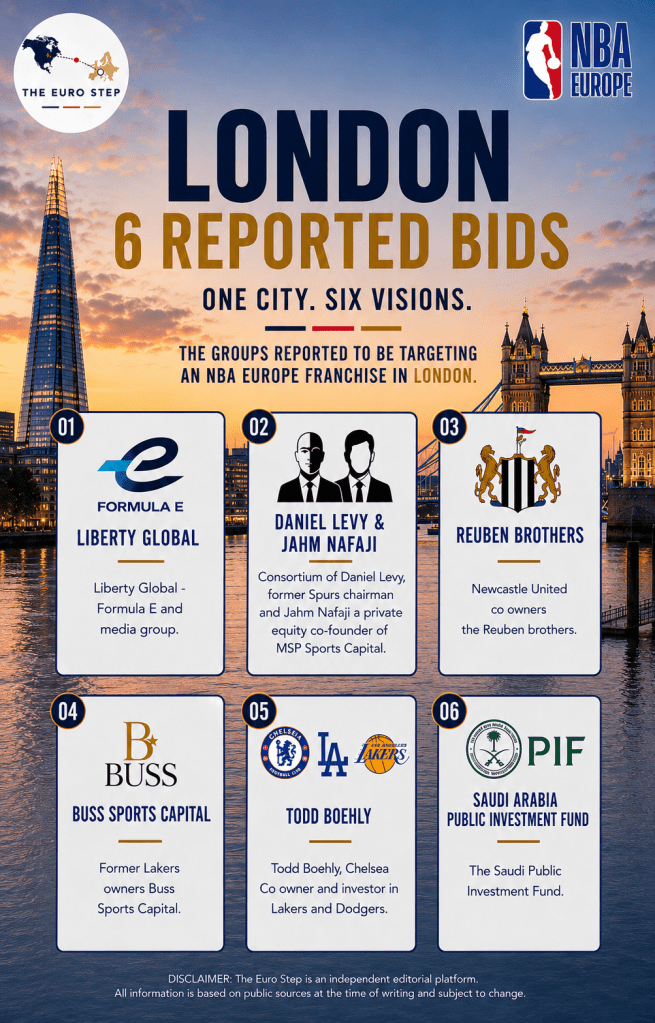
According to Sky Sports, six significant investment groups have emerged as reported bidders for a London NBA Europe franchise. They include Liberty Global; a consortium led by former Tottenham Hotspur chairman Daniel Levy and private equity executive Jahm Najafi; the Reuben Brothers; Buss Sports Capital, representing the family synonymous with the Los Angeles Lakers; Chelsea co-owner Todd Boehly; and Saudi Arabia’s Public Investment Fund.
Individually, each name is noteworthy. Collectively, they reveal something much bigger. These organisations are not competing to acquire an established European basketball powerhouse with generations of history behind it. They are competing for the opportunity to create one.
That distinction matters. It suggests the greatest asset on offer is not an existing basketball club but the opportunity to own the NBA’s future in one of the world’s most valuable sporting markets. Seen through that lens, the reported bidders begin to make far more sense.
Daniel Levy’s inclusion may surprise basketball fans, but commercially it is one of the most logical names on the list. Football supporters have often debated his leadership of Tottenham Hotspur, particularly when discussing transfers or silverware, yet his reputation inside the sports industry has been built on something very different. Levy oversaw the development of one of Europe’s most advanced stadiums while securing a long-term partnership with the NFL that transformed Tottenham Hotspur Stadium into the league’s permanent home in Britain. Those achievements demonstrate expertise in infrastructure, commercial partnerships and the relationship between American and European sport. If NBA Europe is seeking operators capable of building a franchise rather than simply owning one, Levy’s experience begins to look less surprising and considerably more strategic.
Todd Boehly offers a different but equally compelling profile. Through his investments in the Los Angeles Dodgers, the Los Angeles Lakers and Chelsea, Boehly operates comfortably on both sides of the Atlantic. Few investors understand American franchise sport and elite European football as intimately. As the NBA attempts to introduce its franchise model into Europe’s unique sporting landscape, that combination of experience could prove invaluable.
Then there is Buss Sports Capital. The Buss name is inseparable from the history of the Los Angeles Lakers, one of the NBA’s defining organisations. More than championship banners, it represents decades of experience in operating one of the league’s flagship franchises. If the NBA values institutional knowledge alongside investment capital, it is easy to understand why that connection would carry weight.
The remaining bidders broaden the picture even further. Liberty Global approaches the opportunity from a media and communications perspective rather than traditional team ownership. Modern sport is increasingly driven by distribution as much as competition, and few organisations understand how premium content reaches millions of consumers across Europe better than a business deeply embedded in telecommunications and broadcasting. If NBA Europe is intended to become a continent-wide media product, that expertise may be just as strategically important as basketball experience itself.
Meanwhile, the reported involvement of the Reuben Brothers and Saudi Arabia’s Public Investment Fund reflects another reality of modern global sport. Sovereign wealth, private equity and institutional investment have become increasingly influential across football, Formula One and other major competitions. Their presence here suggests investors see NBA Europe not simply as a sporting project, but as a long-term commercial opportunity capable of appreciating significantly over time.
Perhaps that is the most revealing point of all.
These investors come from different industries, different countries and different sporting backgrounds. They approach sport through different commercial models and possess very different expertise. Yet they have all arrived at the same conclusion.
London is not simply another expansion market.
It is the prize.
Update: A New Name Emerges
Since this article was first published, fresh reporting has suggested that technology executive and investor Nikesh Arora is in discussions regarding a potential London NBA Europe franchise. If confirmed, it would place another high-profile investor alongside the growing list of groups previously linked with the capital.
While the identity of the eventual ownership group remains uncertain, the calibre of investors now associated with London continues to reinforce the city’s position as one of the NBA’s most strategically valuable expansion markets.

The Existing Player
One of the most intriguing aspects of London’s position is that the city’s leading basketball organisation does not appear to sit at the centre of the reported bidding process.
The London Lions remain Britain’s flagship basketball club and, despite a turbulent period following the collapse of former owners 777 Partners, the organisation has quietly rebuilt under new ownership. Acquired by Lithuanian technology company Tesonet, best known for its ownership of NordVPN, the club has regained stability while continuing to invest in a long-term vision under chief executive Lenz Balan. Rather than retreating after a period of uncertainty, the Lions have continued to speak about growth, infrastructure and London’s place in the future of European basketball.
What makes that position particularly interesting is that, unlike many of the reported investors pursuing an NBA Europe franchise, the Lions are not attempting to enter the London market.
They are already part of it.
While the wider conversation has become dominated by consortiums, private equity, sovereign wealth and American sports ownership, London’s existing basketball club has continued to develop its own strategy. Rather than waiting to discover the NBA’s intentions, the organisation appears focused on ensuring that, whatever shape European basketball ultimately takes, it remains part of that future.
That confidence has also been reflected in the club’s public messaging. Balan has consistently described NBA Europe as an opportunity rather than a threat, recognising that greater investment could strengthen basketball across the continent rather than undermine existing organisations. The investment of NBA forward OG Anunoby, himself born in London, reinforces that long-term belief, while reported EuroLeague interest suggests the Lions are exploring multiple pathways rather than tying their future to a single outcome.
The result is an unusual situation. While investors compete to shape London’s basketball future, the city’s leading club is quietly preparing for whichever future eventually arrives.

Building For The Future
The same sense of confidence is evident away from the boardroom.
Infrastructure often provides the clearest indication of what sophisticated investors genuinely believe. Businesses do not commission feasibility studies, acquire land or develop arena proposals on the assumption that opportunities might appear one day. They do so because they believe demand is coming. In London’s case, that confidence is increasingly visible.
The London Lions have already completed feasibility work suggesting the capital could support a significantly larger venue than the current 6,000-seat Copper Box Arena, reflecting a belief that professional basketball’s long-term ceiling is considerably higher than its present reality. Alongside those ambitions sits the entirely separate proposal for the London Colosseum, a planned 25,000-seat arena designed specifically with NBA Europe in mind. Its backers have been remarkably open about their ambition for the venue to become the home of a future franchise.
Viewed individually, each project represents an ambitious investment in London’s sporting future. Viewed together, they become something more significant. They suggest that multiple organisations, operating independently of one another, have reached the same conclusion about where European basketball is heading. Arena developers are preparing. Investors are preparing. Basketball organisations are preparing. The NBA is simply deciding how that opportunity should ultimately be realised.
That perspective also gives greater context to one of Lenz Balan’s most revealing observations. When he suggested that London could one day support two professional basketball franchises, it was not simply an expression of optimism. It reflected a belief that London’s scale makes it fundamentally different from almost every other market under consideration. Most European cities are debating whether they can sustain one elite club. London is already beginning to ask whether it could eventually sustain two.
Whether that scenario ever materialises remains uncertain. What matters is that respected figures across the sport now believe it is a conversation worth having. That alone illustrates how dramatically perceptions of London’s basketball potential have shifted.
The Prize
At this stage there is little value in attempting to predict which of the reported bidders will ultimately secure a London franchise. Each arrives with different strengths. Some possess extraordinary financial resources. Others bring decades of experience operating global sports organisations. Several already understand London’s sporting landscape better than anyone, while others offer expertise in media distribution, infrastructure and international investment that could prove equally valuable.
It would not be surprising if the eventual ownership structure reflected that diversity rather than relying upon a single investor. Modern sport has increasingly become a collaborative business, bringing together financial backing, commercial expertise and operational experience. Should NBA Europe follow that model, London’s eventual franchise could emerge from a partnership rather than a single successful bidder.
In many ways, however, the identity of the eventual owner has become secondary to what the bidding process itself reveals.
Media companies. Sovereign wealth. Private equity. Premier League executives. NBA ownership families.
They have all arrived at the same conclusion.
London is not simply another expansion market.
It is the prize.
 The Euro Step
Leave a comment