Just days after rejecting the NBA’s proposal, EuroLeague unveiled a €13 billion vision for its future. Beyond the financial projections lies a more fundamental battle: convincing Europe’s biggest clubs that staying is worth more than leaving.
BEYOND THE ARC | THE EURO STEP
When EuroLeague’s thirteen shareholder clubs gathered at Lake Como on 6 October, the future of European basketball was once again on the agenda. Among the matters under consideration was a formal proposal from the NBA, the latest development in negotiations that have increasingly exposed the competing ambitions of the two organisations. The proposal was rejected, although the possibility of further discussions remained open. Ten days later, EuroLeague announced an ambitious ten-year business plan, projecting that the combined value of its competition and licensed clubs could exceed €13 billion.
Taken independently, the two developments appear to tell a straightforward story. The NBA is preparing to establish a new European competition, while EuroLeague is strengthening its own commercial structure. Both organisations believe European basketball possesses considerable untapped value, and both are developing business models designed to capture it. Yet the timing of EuroLeague’s announcement, alongside its franchise reforms and efforts to attract investment, raises another possibility. Rather than simply preparing to compete with the NBA, EuroLeague may also be strengthening its position in the event that cooperation eventually becomes unavoidable.
The distinction matters because the future of European basketball will not be determined by financial projections alone. It will depend on the decisions of the clubs that give those projections credibility. For EuroLeague, retaining institutions such as Real Madrid, Panathinaikos and Fenerbahçe is fundamental to the value of the competition itself. If those clubs remain, EuroLeague retains the assets that make it an attractive commercial partner. If they depart, even the most ambitious business plan could become difficult to justify.
Establishing the Value of European Basketball
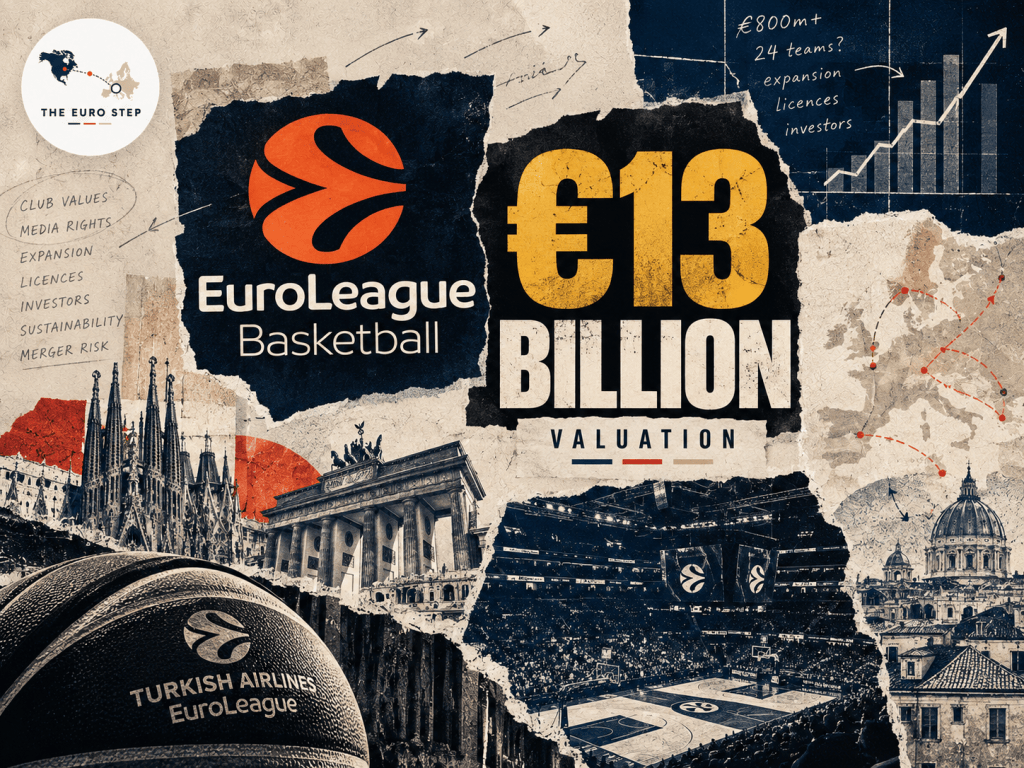
EuroLeague’s latest financial projections represent a substantial increase in its long-term commercial ambitions. Under the new ten-year plan, the combined enterprise value of the league and its licensed clubs is expected to grow from approximately €3.2 billion to €13.38 billion. Within that figure, the value of the clubs is projected to rise from €1.8 billion to €5.4 billion, while the central league business would increase from approximately €1.4 billion to €7.98 billion. Annual commercial revenues are targeted to reach €648 million by the end of the period, with total distributions to participating clubs projected at €3.4 billion across the decade.
These figures should not be mistaken for an immediate revaluation of EuroLeague’s existing assets. The €13.38 billion represents a projected future value, dependent on the successful implementation of significant commercial reforms. EuroLeague’s financial transformation was also underway before the NBA’s latest proposal was rejected. Earlier valuations prepared by JB Capital placed the combined value of the competition and its clubs at approximately €3.2 billion, with the potential to reach €4.3 billion following changes to the ownership structure. The latest announcement therefore represents an extension of an existing strategy rather than an entirely new response to the NBA.
Nevertheless, the timing is significant. By publicly outlining the potential value of its business over the next decade, EuroLeague is establishing a financial reference point against which future investment proposals and partnership arrangements can be assessed. This is particularly relevant when the NBA is reportedly attracting prospective franchise investments ranging from $500 million to more than $1 billion. Although those figures cannot be directly compared with EuroLeague’s enterprise valuations, they demonstrate the scale of capital potentially available to European basketball.
The transition from long-term licences to permanent franchises is central to EuroLeague’s ambition. By creating more secure ownership positions, the competition hopes to increase the value of its existing shareholders while attracting new investors. Established clubs would receive these franchise rights through the conversion of their existing licences, rather than paying the entry fees required of new applicants. The arrangement offers existing shareholders the prospect of holding more valuable assets without making the same initial investment demanded of incoming franchises.
This could have important implications for future negotiations with the NBA. A EuroLeague whose shareholders possess clearly defined franchise rights, supported by independent valuations and projected commercial growth, would enter discussions from a different position than a collection of clubs holding traditional participation licences. The organisation would be better placed to argue that its existing assets represent a substantial contribution to any combined competition, potentially influencing negotiations over ownership, governance and future revenues.
There is no direct evidence that EuroLeague has increased its valuation ambitions specifically to establish parity with the NBA. However, strengthening the value of its existing assets would be advantageous whether EuroLeague ultimately chooses to compete independently or pursue a partnership. In either scenario, the organisation has an incentive to demonstrate that European basketball’s established institutions possess commercial value that cannot simply be replicated through new investment.

The Importance of Keeping the Clubs
For all the attention surrounding franchise valuations and commercial forecasts, EuroLeague’s greatest vulnerability remains the possibility of losing its most important clubs. Its business model depends on the collective appeal of the institutions that participate in the competition, and their commercial contributions are not necessarily equal. The departure of a major European basketball brand could have consequences extending well beyond the loss of a single shareholder.
Real Madrid provides perhaps the clearest example. Its basketball team possesses an extraordinary European history, but the institution’s commercial appeal also benefits from the international recognition of its football operation. The Real Madrid name offers immediate credibility in markets where European club basketball has traditionally struggled to establish itself. For the NBA, securing its participation could provide an enormous advantage when launching a new competition. For EuroLeague, losing it would weaken one of the most recognisable elements of its existing commercial proposition.
Similar considerations apply to Panathinaikos, Fenerbahçe and other established institutions, albeit with different commercial characteristics. Their value is not limited to individual financial performance. They contribute to the wider appeal of the competition through their supporters, rivalries and sporting histories, influencing broadcasting interest, sponsorship opportunities and the attractiveness of the league to prospective investors.
EuroLeague’s revised economic distribution model appears designed, at least in part, to recognise these differences. Under the new arrangements, licensed clubs will retain 65% of net broadcasting revenues generated within their respective markets, while the remaining 35% will be distributed equally. Other commercial distributions will increasingly reflect sporting performance, audience engagement and historical contribution. This provides clubs with stronger incentives to develop their own commercial operations while remaining part of the collective competition.
The significance becomes clearer when considered alongside the NBA’s interest in Europe’s leading institutions. EuroLeague is not simply promising that its competition will become more valuable; it is attempting to demonstrate how individual shareholders can benefit from that growth. For clubs considering alternative opportunities, the relevant comparison is therefore not just between two competitions, but between the potential long-term value of two different ownership and revenue structures.
There is, however, considerable uncertainty surrounding EuroLeague’s projections. Its anticipated growth depends on attracting investment, increasing commercial revenues and retaining the sporting appeal that underpins its current position. Should several major clubs depart, broadcasters, sponsors and prospective investors would need to reassess the value of the remaining competition. The assumptions supporting its long-term valuations could change substantially.
This creates an important imbalance between the competing organisations. The NBA does not necessarily need every established EuroLeague club to launch a credible European competition. It could build around a selection of major institutions, new ownership groups and commercially attractive cities. EuroLeague, by contrast, needs to preserve enough of its existing collective strength to maintain its position as Europe’s leading club competition. The NBA must assemble a compelling product, while EuroLeague must prevent the fragmentation of the one it already possesses.

Rome and the Value of Positioning
The emerging franchise opportunity in Rome offers an interesting illustration of how investors may be responding to this uncertainty. BC Roma SPQR, a project associated with Luka Dončić and former Dallas Mavericks executive Donnie Nelson, has reportedly submitted a binding bid for a EuroLeague franchise. The development is particularly intriguing given the project’s previous association with ambitions involving NBA Europe, and the inclusion of Rome among the markets identified as potentially attractive for the NBA’s expansion.
At first glance, the decision to pursue EuroLeague membership might suggest that investors are choosing one competition over the other. However, that interpretation assumes the two organisations will remain permanently separate, an outcome that is far from certain. For an investor seeking to establish a major basketball institution in Rome, there may be considerable value in securing a position within the existing European basketball structure while the relationship between EuroLeague and the NBA remains unresolved.
If EuroLeague continues independently, a successful franchise application would provide Rome with access to an established competition and its developing commercial model. If NBA Europe launches separately, an existing EuroLeague franchise could offer a stronger sporting and commercial foundation from which to pursue future opportunities, although contractual obligations could restrict its freedom to move. Should the two organisations eventually agree on some form of integration, an established franchise might also occupy a more advantageous position than a project seeking admission from outside the existing structure.
This does not mean Rome’s investors are necessarily anticipating a merger. Their immediate motivation may simply be to establish a competitive basketball operation in an attractive European market. Nevertheless, the possibility that existing membership might carry value under several different future scenarios provides a rational explanation for pursuing a position now. In an uncertain market, establishing a valuable basketball institution could be a way of positioning for more than one outcome.
The broader implication is that investors may not view EuroLeague and NBA Europe as entirely separate long-term opportunities. If cooperation remains possible, participation in one competition could potentially influence an investor’s position in a future combined structure. EuroLeague’s expansion process may therefore attract capital from groups interested not only in the competition as it currently exists, but also in the wider commercial development of European basketball.

Building a Competitor, or Building a Merger Partner?
The rejection of the NBA’s proposal has encouraged the interpretation that European basketball is moving towards direct competition between two rival organisations. EuroLeague is developing its franchise model and long-term commercial strategy, while the NBA continues to pursue its own European project alongside FIBA. Neither organisation has publicly committed to abandoning its preferred structure.
Yet their commercial ambitions share many of the same assumptions. Both believe European basketball can attract greater investment, generate more substantial broadcasting and sponsorship revenues, and develop a stronger presence in major European cities. Both are seeking to create more valuable franchises and establish business models capable of attracting institutional investors.
There is a credible argument that increased competition could accelerate the development of European basketball. New investment may improve facilities, strengthen marketing and create opportunities in cities where the sport has historically been underdeveloped. However, competing competitions would also seek broadcasting agreements, sponsors, investors and audiences within many of the same markets. They could compete directly for established clubs, weakening the commercial appeal of the organisations those clubs leave behind.
The economic case for cooperation therefore remains significant. A combined structure could potentially unite EuroLeague’s established sporting assets with the NBA’s global commercial expertise, reducing duplicated investment and limiting competition for the same audiences. Such an arrangement would still require difficult negotiations over governance, ownership, revenue distribution and the relationship with domestic basketball, but it could offer a more coherent commercial proposition than two competing structures.
In this context, EuroLeague’s business plan may serve a dual purpose. Its franchise reforms, new investment commitments and valuation targets strengthen its ability to operate independently, while potentially improving its position in future negotiations. By increasing the value of its existing assets and creating stronger financial incentives for shareholders, EuroLeague may be attempting to ensure that any eventual cooperation recognises its contribution to European basketball.
The organisation does not need to be actively planning a merger for this strategy to make sense. Preparing to compete and preparing to negotiate from strength can involve many of the same decisions. Both require financial credibility, valuable assets and the continued support of key stakeholders. Indeed, demonstrating that EuroLeague could prosper independently may be one of the strongest arguments it can bring to any future discussion with the NBA.
The Clubs Hold the Cards
EuroLeague’s latest business plan represents an ambitious attempt to transform the commercial foundations of European basketball. Its projected valuations, franchise reforms and investment commitments demonstrate an organisation seeking to capture more of the value generated by its established competition. The NBA’s arrival has introduced a new level of investment interest and an alternative vision for the sport, but it has also increased the urgency with which EuroLeague must address its existing limitations.
The decisive question is whether those reforms will be sufficient to retain the institutions upon which EuroLeague’s value depends. If Real Madrid, Panathinaikos and other leading clubs remain, EuroLeague preserves much of the sporting credibility and commercial leverage required to negotiate with the NBA on stronger terms. If they leave, the departure of those institutions could undermine both its financial projections and its position in future discussions.
The reported interest in Rome illustrates how this uncertainty may already be influencing investment decisions. Establishing a position within EuroLeague could offer value under several possible outcomes, including the eventual emergence of a more integrated European basketball structure. While there is no evidence that such an outcome is inevitable, investors have good reason to consider the possibility when committing substantial capital to a market undergoing fundamental change.
Ultimately, EuroLeague’s €13 billion vision may be as much about preserving its negotiating position as projecting future growth. By offering shareholders a more valuable ownership model and demonstrating the investment available to the competition, it is attempting to make remaining within EuroLeague an increasingly attractive proposition. At the same time, those reforms could make the organisation a more substantial partner should negotiations with the NBA resume.
The future of European basketball may therefore depend less on which organisation presents the most ambitious business plan, and more on which can secure the commitment of the clubs that make those plans commercially credible. The NBA has the brand, investment interest and international expertise to create a new competition, while EuroLeague possesses much of the sporting history and institutional strength that such a competition would seek to attract.
EuroLeague has established what it believes its future could be worth. The next question is whether its biggest clubs agree.


Leave a Reply